Historical Lens

Reading the “Man of Law’s Tale” through a historical lens allows for a better understanding of the Man of Law’s complex character, and how Chaucer exhibits a historic and political awareness within the tale.
Note: Proceed to an interactive visual guide by clicking here.
Who is the Man of Law?
Chaucer ascribes a complex voice to the Man of Law and presents him as a character open to interpretation. The Man of Law is not someone who has studied the formal laws of the land, but rather a lawyer with an education based on reported cases, and an ability to remember previous convictions and applied law from the time of William the Conqueror.1 Chaucer refers to his pilgrim as a “Sergeant of the Lawe.”2 Not many medieval lawyers had the honor of rising to the status of sergeant as a result of representing the king’s interests. The Man of Law is, also, part of a twelve-member group of assize justices appointed by the royal authority, and is “a royal judge in waiting.”3 As a result, he has a range of commitments within the legal system, including “the administration of justice in the provinces.”4 The Man of Law is someone who appreciates the moral and legal obligations of promises and displays trustworthiness by being presented as a successful lawyer. Chaucer does not explicitly portray the Man of Law as a corrupt lawyer, which was a trope used by many medieval authors. Instead, he presents a technique used by lawyers in practice, which was the use of technical words like “‘fee symple’, ‘termes’, ‘endite’, ‘acquiteth’, ‘assente.’”5 The legal language proves the Man of Law’s professionalism and creates an intellectual distance between him and the reader, raising questions about the Man of Law’s morality and trustworthiness.6
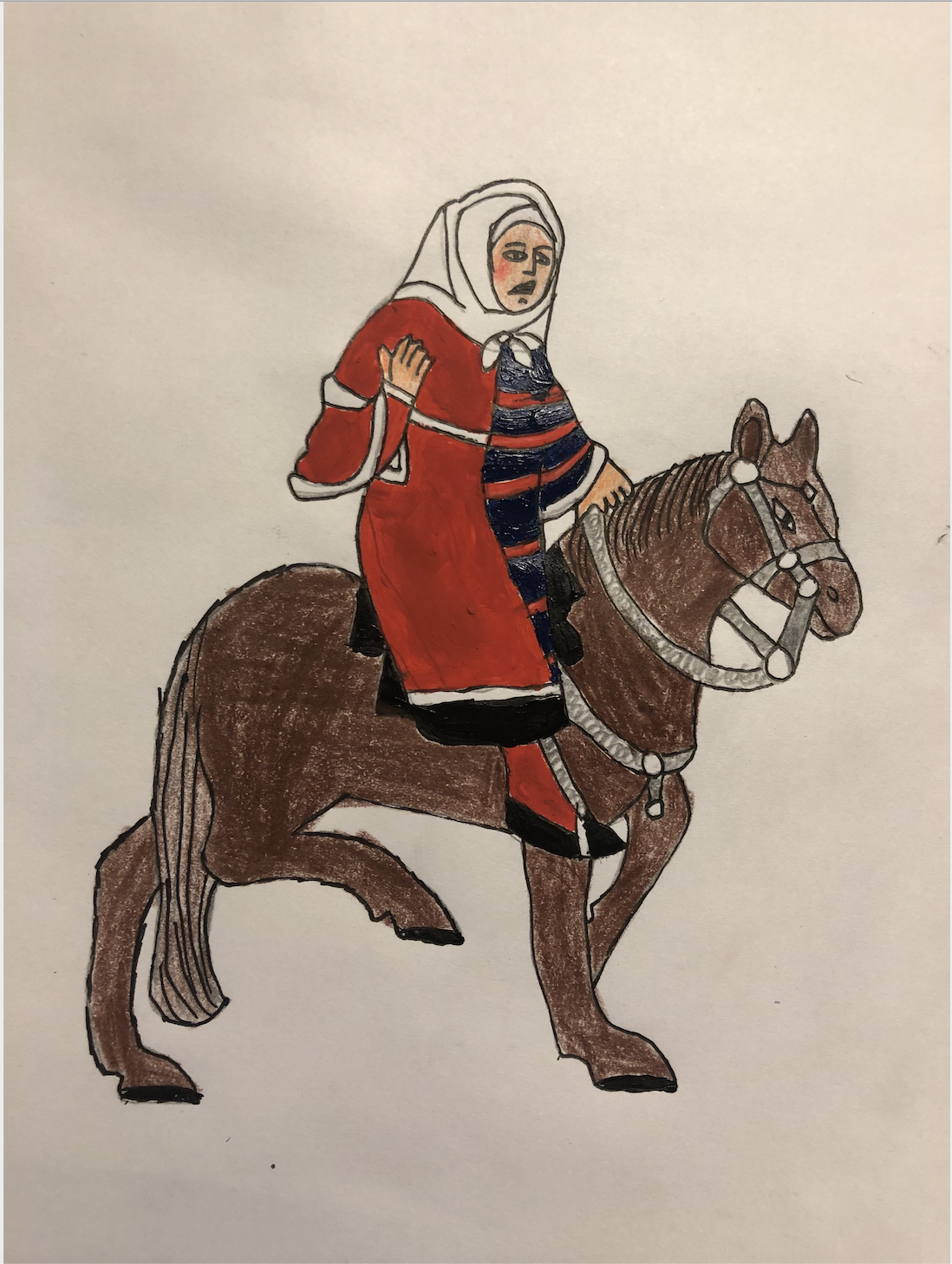
Unlike the descriptions of the other pilgrims in the “General Prologue,” Chaucer refrains from discussing the Man of Law’s physical features in depth. Musson suggests that Chaucer could have modeled the Man of Law after Thomas Pynchbeck, an appointed sergeant and Chief Baron of the Exchequer.7 The only reference Chaucer makes to the Man of Law’s attire is when he says the pilgrim is riding “hoomly in a medlee cote.”8 Chaucer does not depict the Man as wearing his entire professional attire. For instance, Chaucer does not mention whether the Man is wearing a coif, which was a professional headdress worn by sergeants. This could be either a questioning of the Man’s moral principles or signaling that he is off-duty.9 The Man could, also, be downplaying his wealth and accomplishments by dressing homely, which means he is elevating his legal knowledge verbally by being an outstanding wordsmith.10
Legal Corruption and Defense
“Ther-to he koude endite and make a thyng,
Ther koude no wight pynche at his writyng;
And every statut koude he pleyn by rote.”10
In the “General Prologue,” Chaucer says the Man of Law can write a case with which no one can find fault.12 He describes the Man of Law as having a wide reputation and unbeatable legal skills.
In “The Man of Law’s Prologue,” the Host imposes his authority as the judge by telling the Man of Law, “Ye been submytted, thurgh youre free assent / To stonden in this cas at my juggement.”13 Considering the historic event of the Rising of 1381, which was the rise of rebels against legal corruption, the Host’s behavior would have registered to the pilgrims as aggression against lawyers and a challenge to the lawyer of the group.14 This motivates the Man of Law to defend his case and eliminate any blame of corruption from his reputation by saying, “Hooste…depardieux, ich assente”15 and agreeing to submit to the Host’s authority. However, by the use of the word ‘depardieux,’ he gives the highest legal authority to God.16 Later, by establishing himself as a poor narrator, the Man gives literary authority to Chaucer and demonstrates that he is not manipulating the tale.17
The Man of Law tells a carefully constructed tale in which he weaves divine law into the narrative to defend himself against mistrust and notions of corruption. Johnson examines the legal scenes from the tale that reinforce the theme of divine law as the true law of England.18 After a deceiving knight blames Custaunce for the murder of Hermengyld in the non-Christian land of Northumberland, the Man presents a legal scene of jury testimony where King Alla questions his people on whether Custaunce is guilty despite having the bloody knife as physical evidence. The people respond that they “kan nat gesse / That she had doon so greet a wikkednesse.”19 The Northumbrians do not challenge Custaunce’s character, and her neighbors attest to her goodness. Then, King Alla questions the knight’s claim as “A Briton book, written with Evangiles / [is] fet, and on this book [the knight] swoor.”20 The Man of Law emphasizes that the role of community testimony and public opinion in the legal process is a vital part of English law. He reassures his fellow pilgrims that divine law is at the foundation of English law by putting the knight’s claim to trial by sacred oath over a book containing the Gospels.21 The Man of Law effectively uses his knowledge of the history of English law to persuade the pilgrims that he is against legal corruption. He does this by positioning himself as a representative of the English law that derives “its authority from God and from the ancient nobility of pre-Anglo-Saxon England.”22 After God decides the final verdict and punishes the knight for lying under sacred oath, it induces the conversion of the land to Christianity and results in the marriage of Custaunce and King Alla. Custaunce gives birth to a son while the couple is physically separated by distance and forced to communicate through letters. Donegild, the ‘fiend-like’ mother-in-law, is not happy with the religious conversion of the land and “[counterfeits] ful subtilly / Another lettre wroght ful sinfully,”23 to the King instead of the original from Custaunce. This letter describes the son as “so horrible a fendlich creature.”24 She, also, falsifies the return letter from Alla promising to love the child regardless, in which Donegild writes an order of banishment, “in the same ship as [the constable] hir fond / Hire, and hir yonge sone…He sholde putte, and croude…fro the lond.”25 Through this scene, the Man of Law demonstrates how the divine law of England, personified through the marriage, is affected by forged documentation. By doing this, he warns the pilgrims of “the dangers of relying on documentation” and aligns himself with those who feel the moral obligation of “liberat[ing] the law from misuse.”26
Mythical Genealogy and Monarchy

During the second decade of his reign, Richard II faced legal challenges to his rule, and lawyers had an essential role in reinterpreting English and foreign law to defend the King’s authority and privileges.27 Political sovereignty largely depended on the convention of mythical genealogy, in which the medieval kings of Europe traced their ancestry back to the first Romans and King Arthur to establish a divine right to rule and an inherent nobility.28 Chaucer represents the convention of mythical genealogy in the “Man of Law’s Tale” by alluding to the legend of King Arthur through his depiction of the pagan King Alla of Northumberland who converts to Christianity. Chaucer portrays a legitimate transfer of power from a pagan ruler to a Christian monarch by narrating through the voice of the Man of Law, a sergeant-at-law deeply invested in the King’s affairs.29 The Man of Law constructs a scene with legal technicality, where Custauce is on trial after the murder of Hermengyld in the pagan court of King Alla, and the knight ‘suing’ her is forced to swear an oath on “A Briton book, written with Evangiles.”30 The oath is legally binding and a product of Roman and Saxon law, where King Alla gives textual authority to the Christian Gospels while practicing the Saxon custom of swearing an oath.31 Through this portrayal, the Man of Law, as one of the twelve high-rank lawyers, actively supports the mythical genealogy that accounted for the historically linear succession of English monarchs.
Footnotes.
1Musson. “The Sergeant of Law.” In Historians on Chaucer: The ‘General Prologue to the Canterbury Tales. 209.
2Chaucer. “General Prologue.” I. 309.
3Musson. “The Sergeant of Law.” 212.
4Musson. 212.
5Musson. 208.
6Musson. 213.
7Musson. 222.
8Chaucer. “General Prologue.” I. 328.
9Musson. “The Sergeant of Law.” 224.
10Johnson. “English Law and the Man of Law’s ‘Prose’ Tale.” 508.
11Chaucer. “General Prologue.” I. 325-327.
12Johnson. “English Law and the Man of Law’s ‘Prose’ Tale.” 505.
13Chaucer. “The Man of Law’s Prologue.” II. 35-36.
14Johnson. “English Law and the Man of Law’s ‘Prose’ Tale.” 509.
15Chaucer. “The Man of Law’s Prologue.” II. 39.
16Johnson. “English Law and the Man of Law’s ‘Prose’ Tale.” 510.
17Johnson. 513.
18Johnson. 515.
19Chaucer. “The Man of Law’s Tale.” II. 622-623.
20Chaucer. II. 666-667.
21Johnson. “English Law and the Man of Law’s ‘Prose’ Tale.” 516.
22Johnson. 517.
23Chaucer. “Man of Law’s Tale.” II. 746-747.
24Chaucer. “Man of Law’s Tale.” II. 751.
25Chaucer. “Man of Law’s Tale.” II. 799-801.
26Johnson. “English Law and the Man of Law’s ‘Prose’ Tale.” 518.
27Dugas. “The Legitimization of Royal Power in Chaucer’s “Man of Law’s Tale”.” 28.
28Dugas. 29-30.
29Dugas. 31.
30Chaucer. “Man of Law’s Tale.” II. 666.
31Dugas. “The Legitimization of Royal Power in Chaucer’s “Man of Law’s Tale”.” 33.
